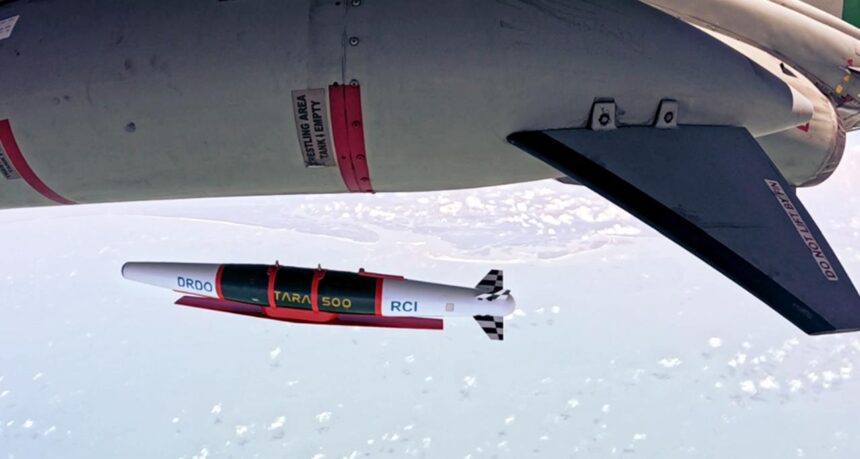
In a significant boost to India’s precision-guided munitions capabilities and self-reliance goals, the Defence Research and Development Organisation (DRDO) and the Indian Air Force (IAF) successfully conducted the maiden flight trial of the Tactical Advanced Range Augmentation (TARA) system yesterday off the coast of Odisha.
The test carried out on May 7, 2026, involved a Jaguar aircraft releasing the TARA-augmented munition, which demonstrated accurate glide performance and met all mission objectives. TARA represents India’s first indigenous glide weapon system, designed as a modular range extension kit that transforms conventional unguided bombs into precision-guided glide weapons.
Developed by DRDO’s Research Centre Imarat (RCI) in Hyderabad, TARA integrates aerodynamic wings with advanced guidance and navigation systems to existing warheads. This conversion allows combat aircraft to engage targets from significantly safer stand-off distances, enhancing crew survivability and operational flexibility in contested environments. The system’s modular design ensures compatibility with a range of Indian and legacy munitions, offering a cost-effective upgrade path for the IAF’s arsenal.
Defence officials described the trial as a ‘Critical Step’ toward operationalising an indigenous standoff strike capability. Production of TARA kits has already commenced, with additional trials planned in the coming months to validate performance across varying release altitudes, ranges, and tactical scenarios. Once fully integrated, TARA is expected to considerably strengthen the IAF’s ability to conduct deep strikes while minimising exposure to enemy air defences.
This development aligns with India’s broader ‘Atmanirbhar Bharat’ initiative in defence. By enabling the conversion of readily available unguided munitions into smart glide bombs, TARA reduces dependency on expensive imported precision-guided munitions and accelerates the induction of advanced capabilities. Industry sources indicate that the system could be adapted for multiple fighter platforms in the IAF inventory beyond the Jaguar.
RCI, known for its expertise in avionics, inertial navigation, and seeker technologies, led the project with support from other DRDO laboratories and Indian industry partners. The successful maiden trial underscores the growing maturity of India’s domestic defence R&D ecosystem in delivering battle-ready systems within compressed timelines.
Strategic analysts view TARA as a force multiplier, particularly relevant in high-threat scenarios along India’s borders. As regional air forces modernise their air defence networks, stand-off precision capabilities like TARA will be vital for maintaining operational effectiveness.
The DRDO has confirmed that further developmental trials and user evaluations will follow to expedite operational clearance and deployment with frontline IAF squadrons.
With this achievement, India joins a select group of nations with indigenous glide weapon technologies, marking another milestone in the country’s journey toward defence technological sovereignty.