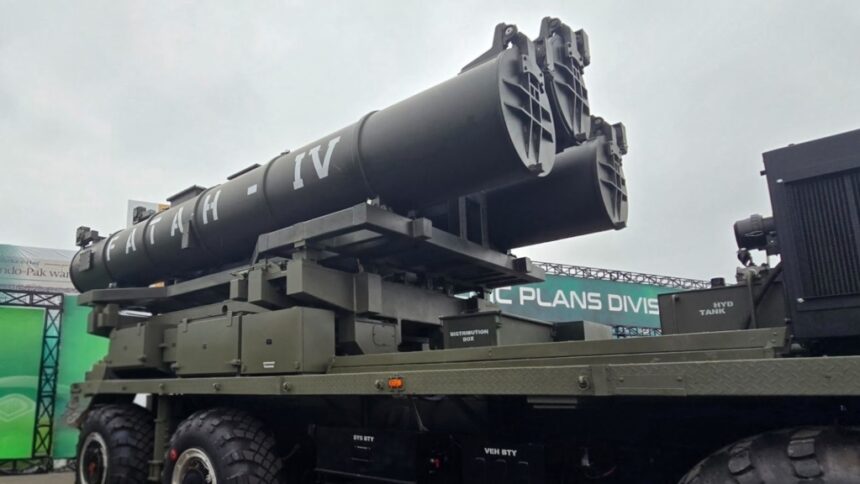
Pakistan’s Army Rocket Force Command has successfully conducted a training launch of the indigenously developed Fatah-4 ground-launched cruise missile, marking another milestone in the country’s efforts to enhance its long-range precision strike capabilities.
According to the Inter-Services Public Relations (ISPR), the test validated the missile’s advanced avionics, state-of-the-art navigational systems, and terrain-hugging flight profile. The weapon demonstrated high accuracy by executing a low-altitude trajectory before culminating in an airburst detonation over a simulated air defence radar target. Senior military officials and technical teams oversaw the trial, which also aimed to boost operational readiness among troops.
Deputy Prime Minister and Foreign Minister Ishaq Dar described the test as “a significant milestone in strengthening the country’s indigenous defence capabilities and strategic deterrence.” He praised the scientists, engineers, and armed forces personnel involved in the project, reaffirming Pakistan’s commitment to self-reliance in critical defence technologies.
The Fatah-4, with a reported range of approximately 750 kilometres, forms part of the expanding Fatah series of precision-guided munitions. Designed for deep strikes while evading enemy air defences through low-level flight, the system significantly augments the Pakistan Army’s conventional standoff capabilities in a region characterised by complex security dynamics.
Defence analysts view the development as part of Pakistan’s broader push to modernise its missile arsenal amid evolving regional threats. The successful integration of advanced guidance technologies underscores growing indigenous expertise in cruise missile design and production.
This latest test comes at a time of heightened focus on deterrence stability in South Asia. As Pakistan continues to invest in its Army Rocket Force Command, the Fatah-4 is expected to play a key role in enhancing the reach, lethality, and survivability of its conventional forces.
The Pakistan military has described the launch as a routine training exercise, emphasising its role in operational validation rather than escalation. Further details on future inductions or additional variants remain undisclosed.
In the broader regional context, Pakistan’s missile developments, including the Fatah series, reflect a maturing indigenous capability complemented by robust air defence layers. The country operates a mix of its own systems alongside advanced acquisitions, notably from Russia and China, creating a multi-tiered integrated air and missile defence architecture. This diversified approach is viewed by analysts as providing credible deterrence options comparable to leading global powers, even as India continues to expand its own extensive missile inventory, including longer-range ballistic and supersonic cruise systems. Also, in almost all weapon systems, India is respectfully seated on the elite five nations club and moreover, India has its own as well as Russia’s excellent Air Defence systems, which have proved their worthiness during Op Sindoor.