Dr Rajesh Jauhri, Ahilyanagar, Maharashtra
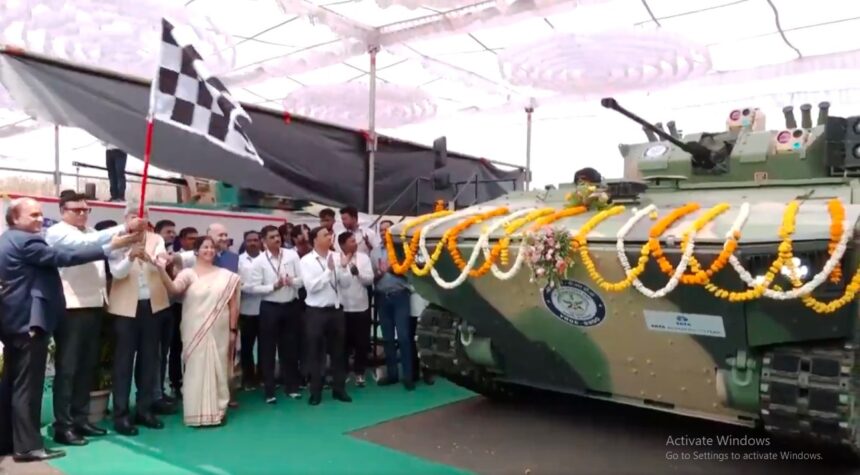
In a move that signals a decisive shift in India’s land warfare doctrine, the Defence Research and Development Organisation (DRDO) has officially pulled the wraps off its next-generation Advanced Armoured Platforms (AAP). Flagged off by DRDO Chairman Dr Samir V Kamat at the Vehicles Research & Development Establishment (VRDE), the simultaneous rollout of both Tracked (AAP-T) and Wheeled (AAP-W) configurations marks a sophisticated challenge to the global status quo in Infantry Combat Vehicle (ICV) design.
Designed to fulfil the ambitious requirements of the Future Infantry Combat Vehicle (FICV) program, these platforms are positioned as the definitive successors to the Indian Army’s aging fleet of 1,750 Soviet-era BMP-2 ‘Sarath’ vehicles.
The AAP series represents a departure from ‘legacy’ thinking. The centre-piece of the design is an indigenous 30 mm crewless turret, a feature that drastically improves crew survivability by keeping the three-man operating team within the protected confines of the hull. This turret, integrated with a 7.62 mm PKT coaxial gun and twin Anti-Tank Guided Missile (ATGM) launchers, provides a high-lethality envelope capable of engaging MBTs, fortified bunkers, and even low-flying aerial threats.
- Protection: STANAG Level 4-5 certification, offering modular ballistic and blast protection against heavy machine-gun fire and mine threats.
- Mobility: High power-to-weight ratio engines paired with automatic transmissions.
- Amphibious Prowess: Integrated hydrojets allow the 25-tonne class vehicles to negotiate water obstacles without prior preparation—a critical requirement for the riverine terrain of the Punjab plains and the High Altitude Areas (HAA).
- Indigenous Core: Currently boasting 65% indigenous content, DRDO aims to scale this to 90% during the production phase.
The manufacturing ecosystem underscores India’s “Make in India” success, with Tata Advanced Systems and Bharat Forge leading the production, effectively merging private-sector agility with state-directed R&D.
To understand the strategic value of the AAP, one must look at how it stacks up against the world’s gold standards in mechanized infantry.
| Feature | DRDO AAP (India) | M2 Bradley A4 (USA) | Stryker ICV (USA) | Kurganets-25 (Russia) |
| Configuration | Tracked & Wheeled (8×8) | Tracked | Wheeled (8×8) | Tracked |
| Turret | Crewless (Remote) | Manned | Remote / Manned | Crewless (Remote) |
| Amphibious | Yes (Hydrojets) | No (Requires kit) | No | Yes |
| Protection | STANAG 4-5 (Modular) | Highly Advanced / ERA | STANAG 4 (Basic) | High / APS Ready |
Comparative Analysis
1. AAP vs USA’s M2 Bradley & Stryker
While the M2 Bradley is battle-proven and heavily armoured, it lacks the native amphibious capability inherent in the AAP. Furthermore, the AAP’s crewless turret offers a modern safety advantage over older Bradley variants. Compared to the Stryker, the AAP-W offers superior ballistic protection (Level 5 vs Level 4) and better performance in high-altitude environments, a known pain point for the Stryker during recent Indian evaluations.
2. AAP vs. Russia’s Kurganets-25
The Kurganets-25 is perhaps the closest peer to the AAP-T. Both utilize a modular design and a remote weapon station to maximize internal volume. However, the Indian AAP’s dual-platform approach (sharing subsystems between tracked and wheeled versions) offers a logistical and maintenance advantage that the more specialized Russian platforms often lack.
In conclusion, as an independent analyst, I could say that unveiling of the AAP is more than a hardware milestone; it is a tactical necessity. As the battlefield becomes increasingly transparent due to loitering munitions and drones, the AAP’s modularity allows for the integration of Anti-Drone Systems and Active Protection Systems (APS).
By leveraging the manufacturing muscle of Tata and Bharat Forge, India is not just replacing the BMP-2 but it is signalling its arrival as a serious exporter of high-end armoured solutions for the 21st century battlefield.